Are You
Emergency Ready?
The Cabinet Office has issued direct advice to be prepared and to be emergency ready. Here is what it says, the tools it provides, and what we think is missing.
Four Situations
Households are asked to be ready for disruption from any of the following.
-
Severe Weather
Storms, flooding and extreme conditions that cut power and block roads.
-
Cyber Attacks
Attacks on the systems that run payments, communications and utilities.
-
Emergencies
War, power outages, natural disasters and state-sponsored terrorism.
-
Disruption to Essential Services
Loss of the water, power, fuel and communications networks households rely on.
Check Whether
You Are Ready
The Government’s Be Ready website provides two documents. Both are free, and both are worth twenty minutes of your time.
The 3-Day Checklist
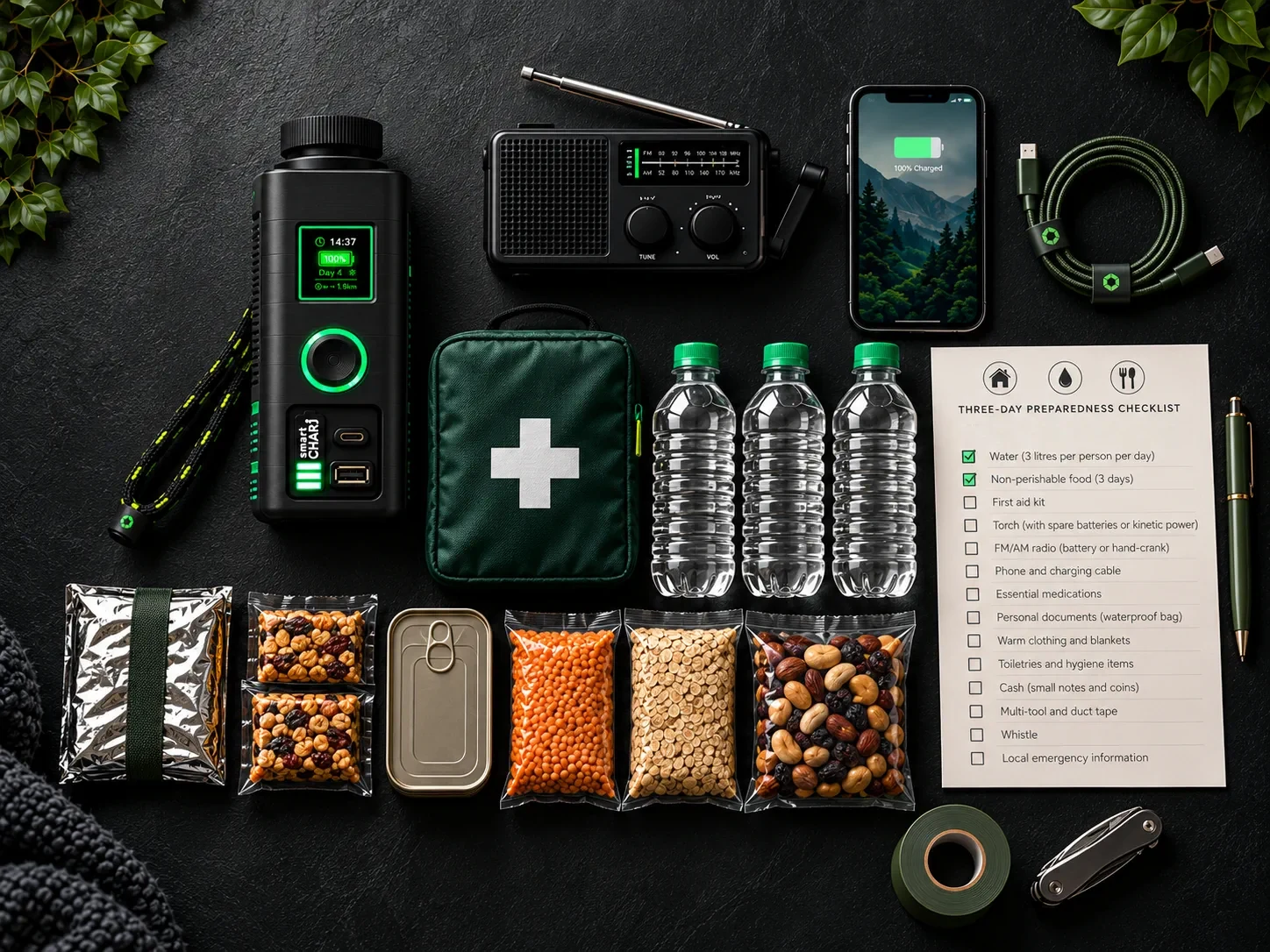
Essential items to see a household through three days without the services it relies on — water, food, light, warmth, communication, medication and documents.
Download the checklist (PDF, opens in a new tab)The Household Emergency Plan
A template to record key phone numbers, medications, insurance details, a meeting point and radio frequencies — the things you will not be able to look up when the power is off.
Download the plan (PDF, opens in a new tab)Both documents are published by the UK Government at gov.uk/beready. © Crown copyright, available under the Open Government Licence v3.0.
Scotland and Northern Ireland
Say the Same
The Cabinet Office is not the only government telling households to prepare. Scotland and Northern Ireland publish their own guidance, and all three lists reach the same conclusion about what belongs in a kit.
Ready Scotland
The Scottish Government’s campaign. Its home emergency kit asks for “a battery-operated torch and spare batteries (or a wind-up torch)” and the same for a radio — then, for power, “a mobile phone charger” and “spare chargers or power banks”. It works to the same three-day supply standard.
Read the Scottish guidance (opens in a new tab)Be Ready for Emergencies
Northern Ireland’s guidance, published on nidirect. Its household emergency kit lists a “battery or wind up radio” and a “battery or wind up torch”, with “spare batteries” and a “spare charger for mobile phone”.
Read the Northern Ireland guidance (opens in a new tab)No Wind-up Charger
on the List
None of the lists specify a wind-up power bank, and that is simply because the devices currently on the market are highly inefficient and can only produce enough power for a very short phone call or to send a text message. Using currently available devices to fully charge a smartphone would take several hours of continuous and exhausting winding. Smart Charj on the other hand can generate enough power, with minimal effort, to fully charge a smartphone from empty in approximately 5 minutes. In addition it can also power tablets, laptops and other essential items needed during a power outage.
This is the gap that Koitech has bridged in the design and development of Smart Charj.
Seven Things We’d
Add to the Checklist
Practical items the official list does not name, which we think earn their place in a 3-day kit.
Face Masks
For smoke, dust and poor air quality.
Charging Cables
A power source is no use without the right lead.
A Siren or Whistle
To signal for help if you cannot be seen.
Pens and Paper
For messages, notes and numbers when screens are dead.
Spectacles or Contact Lenses
Having clear vision should not be compromised.
Toilet Paper
Obvious until it is missing.
A Watch
So telling the time does not cost you phone battery.
We’ll Help You Carry the Load
Koitech Global is developing a sturdy, functional backpack with several pockets, so supplies and personal documents can be packed and found quickly under pressure.

Preparedness Is
Built, Not Bought
Smart Charj is in development, with prototypes targeted for Q3 2027. If you can help with funding, manufacturing or getting it in front of the right people, we would like to hear from you.
Work with us- Households
- Businesses
- Government
Supported / recognised by